
Is Your Record Label Also Your Music Publisher?
As an independent artist, navigating the complexities of the music industry can feel like learning a new language. You pour your heart into creating music, but understanding how to protect your work and get paid for it often leads to a maze of jargon. One of the most common areas of confusion lies in distinguishing between a record label and a music publisher. Are they the same? Do you need both? And how do you, as a DIY musician, ensure you're collecting every penny you've earned?
At TunePact, we believe in empowering independent artists like you with the knowledge and tools to take control of your career. This post will demystify these crucial roles, explain how to master your music publishing, collect all your royalties, and retain full control of your songs, even without a traditional publisher. Let's dive in and unlock your full earning potential!
Introduction: Beyond the Label for Independent Artists
Why Understanding Publishing is Crucial for Your Career
For too long, the intricacies of music publishing have been shrouded in mystery, often perceived as the exclusive domain of major labels and established artists. However, in today's independent music landscape, understanding your publishing rights and revenue streams isn't just beneficial—it's absolutely crucial for your long-term success and financial stability.
Many artists mistakenly believe that once they've released a song, either independently or through a record label, all their bases are covered. This couldn't be further from the truth. Your music generates various types of income, and knowing where each stream originates is key to maximizing your earnings.
This guide aims to cut through the confusion, empowering you to master your music publishing. By understanding these distinct roles, you'll be well-equipped to manage your rights and revenue, ensuring you get paid for every play, stream, and sync. This knowledge is a cornerstone for crafting your independent artist strategy and building a sustainable career.
Record Label vs. Music Publisher: Decoding the Roles
To truly master your music business, you must first grasp the fundamental differences between these two powerful entities. While both play vital roles in bringing music to the world, they deal with entirely different aspects of your creative work.
The Record Label's Domain: Master Recordings
A record label is primarily concerned with your master recordings. Think of a master recording as the actual audio file of your song – the specific performance, production, and mix that listeners hear. The label's responsibilities typically include funding the recording process, manufacturing and distributing your music (physical and digital), marketing and promotion, and securing placements in various media.
When you sign with a record label, you are usually granting them rights to exploit these master recordings in exchange for an advance and a share of the profits. They invest in bringing your sound to the masses, managing the business side of the audio product. They are the ones who get your tracks onto streaming platforms, radio, and retail shelves.
The Music Publisher's Realm: Musical Compositions
In contrast, a music publisher focuses on the musical composition itself. This refers to the underlying song – the melody, lyrics, and harmonic structure – regardless of who performs or records it. The publisher's role involves administering these compositions, which includes registering them, licensing them for various uses (like film, TV, or commercials), and collecting the associated royalties.
To put it simply: "A record label is to master recordings what a publisher is to musical compositions." While a record label deals with the recorded performance, a publisher deals with the written song. It's crucial for independent artists to understand this distinction. For a more detailed comparison, you can read more about distinguishing music publishers from record labels.
It's worth noting that some larger record labels, especially major ones, may have their own publishing divisions (e.g., Warner Chappell Music, Universal Music Publishing Group). Their motivation for this is to gain more control over the entire artistic work and to earn an additional share of royalties from the composition side, creating a more vertically integrated business model.
Demystifying Music Publishing for Independent Artists
Now that we've drawn a clear line between labels and publishers, let's zoom in on the world of music publishing, particularly from the perspective of an independent artist.
The Fundamentals of Music Copyright
Every song you create, comprising its melody, lyrics, and harmony, is legally known as a musical composition. The moment you fix this composition in a tangible form (writing it down, recording a demo), it is automatically protected by copyright. This copyright grants you, the creator, exclusive rights to reproduce, distribute, perform, and display your work, and to create derivative works from it.
Understanding these basics of copyright is absolutely essential for independent artists. It's the foundation upon which all your potential earnings are built. Protecting your work means you control who uses it and how they use it, ensuring you get compensated fairly. This is the core of understanding music publishing for independent artists.
Your Role as a Songwriter and Composer
As the songwriter and composer, you are the original owner of your musical compositions. This means you hold the publishing rights. Many independent artists choose to self-administer their publishing, acting as their own publisher. This gives you maximum control and allows you to collect all of the publisher's share of royalties directly.
A key step in managing your publishing is registering your compositions with a Performing Rights Organization (PRO). In the United States, major PROs include ASCAP and BMI. These organizations are responsible for collecting performance royalties on behalf of songwriters and publishers whenever your music is publicly performed. This includes plays on radio, TV, in venues, and even through streaming services. You can learn more about their role on the ASCAP official website, a leading Performing Rights Organization.
Registering with a PRO is a non-negotiable step for any artist serious about collecting their due performance royalties. It's how your music's public life translates into income.
Unlocking Your Income Streams: Music Publishing Royalties Explained
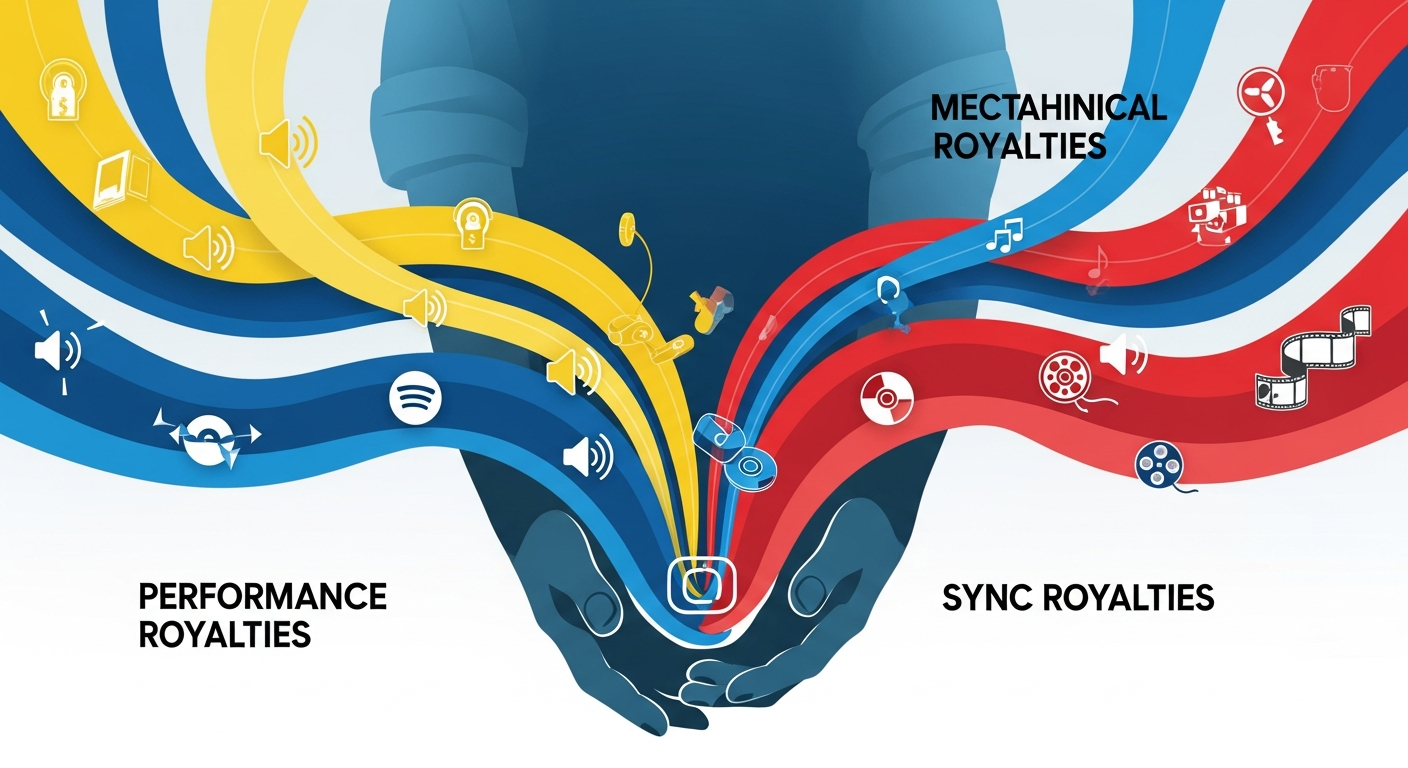
This is where the rubber meets the road for independent artists. Understanding the various types of royalties your compositions generate is critical to ensuring you collect everything you're owed. Let's break down the different categories of music publishing royalties explained.
Performance Royalties: Getting Paid for Plays
Performance royalties are generated whenever your musical composition is publicly performed. This is a broad category and includes:
- Radio Airplay: Both terrestrial and internet radio stations.
- TV Broadcasts: When your song is used in a show, commercial, or movie on television.
- Live Performances: When your songs are performed in venues, clubs, or concerts (even if you're performing them yourself!).
- Digital Streams: Public performances via streaming services like Spotify, Apple Music, YouTube, and others.
These royalties are collected by your Performing Rights Organization (PRO), such as ASCAP or BMI, who then distribute them to both the songwriter and the publisher. Proper registration of your compositions with a PRO is the first and most crucial step to collecting these royalties.
Mechanical Royalties: The Hidden Earnings
Mechanical royalties are generated whenever a musical composition is reproduced. This includes physical reproductions (CDs, vinyl), permanent digital downloads (iTunes, Bandcamp), and, significantly, interactive streams on platforms like Spotify or Apple Music.
Every time your song is streamed on demand, it triggers both a performance royalty (collected by PROs) and a mechanical royalty. For physical and download sales, these royalties are paid by the record label or distributor to a mechanical rights agency (like The Harry Fox Agency in the US) or directly to the publisher. For streaming services, a portion of the subscription revenue is allocated to mechanical royalties, which are then collected by various agencies globally.
It's a common oversight for independent artists to miss out on mechanical royalties, especially those generated by streaming. Ensuring proper registration and metadata for your compositions is vital for collecting these often-overlooked songwriting royalties. The official How Royalties Work on Spotify guide explains the complex system of royalty payments, including both recording and publishing royalties, and emphasizes the importance of proper registration for artists to receive their due share from streaming.
Sync and Print Royalties: Beyond the Airwaves
Beyond performance and mechanical royalties, two other significant income streams for songwriters are synchronization and print royalties.
- Synchronization (Sync) Royalties: These are paid when your musical composition is "synced" with visual media, such as films, TV shows, commercials, video games, or online videos. A sync license grants permission to use your song in this context, and the fee paid for this license is a direct source of income for the songwriter/publisher. Preparing your catalog for these opportunities is key. TunePact offers resources like Sync Licensing for Independent Artists: Prepare Your Catalog the Right Way to help you get started.
- Print Royalties: These royalties are generated when your musical composition is reproduced in printed form, such as sheet music, songbooks, or even lyrics displayed on websites. While perhaps less significant for many modern artists than other royalty types, it's still an income stream that a proactive publisher (or self-publishing artist) would manage.
The importance of accurate metadata and registration cannot be overstated for all types of royalties. Without it, your earnings can get lost in the system. Make sure your song titles, co-writers, PRO affiliations, and International Standard Musical Work Codes (ISWC) are correct and up-to-date across all platforms.
Navigating Publishing Administration and Deal Types
Once you understand what royalties are available, the next step is to figure out how to administer your publishing rights effectively. Independent artists have more options than ever before.
Self-Administration: The Indie Power Play
For many independent artists, self-administration of their music publishing is a powerful and increasingly viable option. By choosing to self-administer, you retain 100% ownership and control over your compositions and collect both the writer's share and the publisher's share of royalties.
The pros of self-administration are significant: complete control, maximum earnings, and direct relationships with PROs and other collection agencies. The cons involve the time and effort required to register songs, track usage, chase down royalties, and understand the complex global landscape of music rights.
However, with platforms and resources available today, managing your own publishing is more accessible than ever. It requires diligence, organization, and a willingness to learn the business side of your art.
Understanding Different Publishing Deals (Admin, Co-Pub, Full Pub)
While self-administration is an excellent path for many, some artists may choose to partner with a publishing administrator or a traditional music publisher. Understanding the various types of music publishing deals is essential before making any commitments:
- Administration Deal: This is the most artist-friendly type of deal if you choose to work with a third party. The publisher (or publishing administrator) takes a commission (typically 10-25%) for administering your compositions – registering them, licensing them, and collecting royalties on your behalf. You retain 100% ownership of your copyrights. This is a common form of publishing administration for artists seeking help without relinquishing control.
- Co-Publishing Deal: In a co-publishing deal, you (as the songwriter) assign a portion of your publisher's share (typically 50%) to the co-publisher. This means the co-publisher owns a portion of the copyright in your compositions for a specified term or in perpetuity. In return, they typically offer an advance and more active services like creative song-plugging and sync placement efforts.
- Full Publishing Deal: This is the most traditional (and often least favorable for artists) type of deal. You assign 100% of your publisher's share and often a significant portion of the copyright itself to the publisher. In exchange, the publisher provides an advance and takes on all administrative and creative responsibilities. These deals are less common for independent artists today unless they are signing with a major publishing house.
When considering any publishing partner, always prioritize deals that allow you to retain as much ownership and control over your compositions as possible. Read contracts carefully, understand the terms, and ensure that any potential partner aligns with your goals as an independent artist.
Maximize Your Earnings: The Independent Artist's Advantage
The journey of an independent artist is one of empowerment and self-reliance. By diligently understanding and actively managing your music publishing, you gain a significant advantage in today's music industry. You are not just a creator; you are an entrepreneur.
Embrace the knowledge that your musical compositions are valuable assets, distinct from your master recordings. By registering your works with PROs, understanding mechanical and sync royalties, and choosing the right administration strategy (whether self-managed or with a trusted partner), you can ensure every royalty stream flows directly to you.
This proactive engagement with your publishing rights translates directly into maximizing your earnings and maintaining complete creative and business control over your songs. No more leaving money on the table; no more confusion. You are in the driver's seat.
TunePact is dedicated to providing independent artists with the tools and insights necessary to streamline their music business operations. From understanding your analytics to managing your releases, we're here to help you navigate this exciting landscape. Compare TunePact's features against platforms like SymphonyOS and discover how we can elevate your music career.
Frequently Asked Questions About Music Publishing
What is the main difference between a record label and a music publisher?
The main difference lies in what they manage. A record label deals with your master recordings (the actual audio files of your songs), handling their production, distribution, and marketing. A music publisher, on the other hand, manages your musical compositions (the underlying song – melody, lyrics, harmony), focusing on licensing, administration, and collecting royalties generated from the use of the song itself, regardless of who performs it.
How do independent artists collect their music publishing royalties?
Independent artists typically collect their music publishing royalties by taking several key steps:
- Registering with a PRO: Join a Performing Rights Organization (PRO) like ASCAP or BMI to collect performance royalties.
- Registering for Mechanical Royalties: Register your works with a mechanical rights administrator (like The Harry Fox Agency or services that help with global mechanicals) or a publishing administrator.
- Direct Licensing: For sync placements, you or your administrator will negotiate directly with film/TV supervisors.
- Metadata Management: Ensure all your song metadata (ISWC codes, co-writers, PRO affiliations) is accurate and consistent across all platforms.
Many independent artists opt for self-administration or use a publishing administration service to help manage these processes.
Do I need a music publisher if I'm an independent artist?
No, you do not necessarily need a traditional music publisher as an independent artist. You can choose to self-administer your music publishing, meaning you take on the role of your own publisher. This allows you to retain 100% ownership and collect both the writer's and publisher's shares of royalties. Alternatively, you can use a publishing administration service, which handles the administrative tasks for a commission while you retain ownership. A full-service publisher might be beneficial for established artists seeking large advances or extensive creative pitching, but it's not a requirement for independent success.
What are the different types of songwriting royalties?
The primary types of songwriting royalties (which come from the musical composition) include:
- Performance Royalties: Generated from public performances of your song (radio, TV, streaming, live venues).
- Mechanical Royalties: Generated from the reproduction of your song (physical sales, digital downloads, interactive streams).
- Synchronization (Sync) Royalties: Fees paid for licensing your song to be used with visual media (film, TV, commercials, video games).
- Print Royalties: Generated from the reproduction of your song in sheet music or lyric books.
Understanding each of these streams is vital for ensuring you collect all due compensation for your creative work.


